Monday, May 31, 2010

2nd Continental Congress


In May 1775, delegates from all colonies assembled once again in Philadelphia for the Second Continental Congress. It would assume the responsibility of war, if it were to arrise by the British.

The Congress sent volunteers from each colony to help the prepare with the Patriots in Boston. Durin this congress was when the Continental Army was created. This army would be commanded by Gral. George Washington.

Some of the radical members of the congress wanted to declare their independence, they also recognized that maybe the people of America were not ready for something like that and wanted to remain loyal to the king.

In July 1775, they sent the Olive Branch Petition to the king, asking for peace between Britain and America. This petition was sort of the white flag in the story. Shamefully, once again the king refused the petition and in return sent even more troops to America.

Wednesday, May 19, 2010

Lexington and Concord


In 1775, there was a great change. General Thomas Gage had been named governor of Massachusetts. So John Hancock together with Samuel Adams and other colonial leaders convened at a Provincial Congress deciding to govern Massachusetts without Gage.

This Provincial Congress also began a stock pile of arms and amunitions.


All this lead to battle.


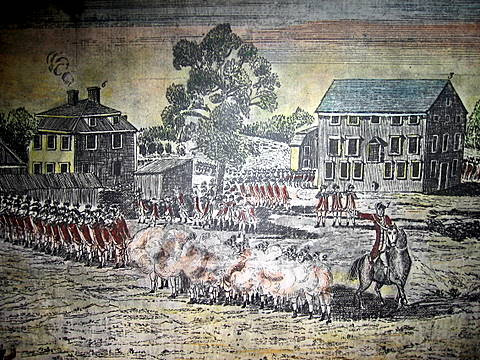
In April of the same year there was war in Lexington and Concord. Gage provoked this battle by sending troops to arrest Adams and Hancock. After they captured them, they were to go to Concord and seize the stockpile.


Luckily the colonists were tipped off about this by Paul Revere, who was sent to Lexington to warn Adams and Hancock. When he got to the town he excliamed the famous quote: "The British are coming, the British are coming." As soon as this warnig came, the local militia run got ready to run off the British troops.

When the troops marched into town, about 70 militia were gathered at Lexington Green, but the British ordered them to disperse. While the militia was dispersing, someone fired a shot, which provoked even more shots to come. When the shooting stopped eight militia men were dead.


So now the red coats (British troops) continued to Concord. They collected the stockpile and then headed back to Boston. On their way back they found trouble. Hundreds of minutemen (colonial militia) had lined up the road hiding behind trees and rocks. So when the red coats passed by, they were supprised attacked by the militia. Benefited from this attack, at the end they had killed 200 red coats.

1st Continental Congress


All the colonies protested against the Intolerable Acts.


In Fall of 1774, delegates of all the colonies, except Georgia's, got together in Philadelphia, Pennsylvania. What was this meeting for? Well, this was the First Continental Congress.


Included in Virginia's delegate was Patrick Henry. He was one of the most outstanding characters in this reunion, remembered by his speech. In this great speech he proclaimed, "The distinction between Virginians, Pennsylvanians, New Yorkers, and New Englanders was no more. I am not Virginian, but American."


They created a boycott to go against these so called "Coercive Acts", and established committees to enforce this boycott. They also estableshed a government that bypassed the British Parliament and the crown. Since they involved common people in these committees, their political activity grew bigger.


After the Congress, in Spring of 1775, all the arriving immigrants marveled the people saying, "They are all Liberty Mad."


Saturday, May 15, 2010

The Intolerable Acts

The Coercive Acts a.k.a The Inrolerable Acts.

All these Boston riots angered the Parliament and the British crown. So to punish them, they passed out the Coercives Acts and to inforce them they sent warships and even more troops.
These were four laws designed to punish Massachusetts and to bring British control over all the colonies.

The Boston Port Act
The Boston Harbor would be closed to all ships until the colonists paid the East India Tea Company for all the tea was destroyed.

Administration of Justice Act
If a British official was accused of a crime in the colonies, he would be sent back to England to face charges there, instead of being tried in the colonies.

Massachusettes Government Act
The colony of Massachusetts was no longer allowed to make its own laws.


Quartering Act
The colonists had to allow British soldiers to live in their homes. They were to be given any access to any building. They could take it over and use it, so colonists had to leave.

Quebec Act
Parliament allowed the colonists to expand the boundries of their holdings farther into Canada.

These acts would last a long time. The harbor closing would keep the fishermen from making a living. There would be no importing, no exporting.
The people of Massachusetts were proud of the self-government they had created, but now they had to put up with the British telling them what to do.
Also sending a British official back to England for trial, was kind of a privilage for the official.
All these act were not to be tolerated by the colonists.

Through the system that the Committe of Correspondance had created, the other colonies soon found out what Massachusttes were going through. So the other colonies gathered supplies and money which were sent to the people in Massachusetts. It's because of this help that Massachusetts was able to survive and defy the British. They still refused to pay back for the lost tea. This lead to the start of a union between the colonies.

The Boston Tea Party

After creating a tea boycott, to but only smuggled tea and not British tea, things went bad. Well bad for the British anyway. It was making the worse for the financial state of the Britsh East India Company. So Parliament allowed the company to sell the tea directly to the colonies. This would make it much cheaper than the smuggled tea.
The colonists said that this wasn't right. They protested that Parliament was only trying to trick them into buying their tea and paying their taxes. So they continued buying the smuggled tea.

The night of December 16th, 1773, some patriots dressed up as indians and boarded the three ships that contained the British tea and they dumped the tea into the harbor.
This event was later on calles The Boston Tea Party.

The Boston Massacre


On March 5th, 1770, a group of colonists started throwing snowball and rocks to some British soldiers who were guarding the Boston custum houses. The soldiers were had been ordered not to fire at the colonists, but out of nervousness and self-defense they started to fire at the colonists. That night 5 colonists were killed. Amoung them was Crispus Attucks, who was believed to have been a run away slave working as a soldier.

Sunday, May 2, 2010

Patrick Henry


Give Me Liberty Or Give Me Death
- Patrick Henry

Henry was born May 29, 1736, in Hanover County, Virginia. His early marriage to Sarah Shelton made him at 35 the father of six children. Henry began his career as a storekeeper and tobacco farmer, but in 1760 he began practicing law. He gained attention throughout the colonies for opposing King George III and the Stamp Act in a speech. He introduced seven resolutions against the Stamp Act. In one speech opposing the act, he stated, "If this be treason, make the most of it." Henry's efforts led the Virginia House of Burgesses to pass five of the seven resolutions he introduced. All seven resolutions were reprinted in newspapers as the Virginia Resolves. Henry grew more radical after the repeal of the act, arguing that the colonies should break away from Great Britain. In 1773, he joined with Thomas Jefferson and Richard Henry Lee to form the Committee of Correspondence to transmit messages throughout the colonies. When the House of Burgesses was dissolved in 1774, he became a member of the Virginia Provincial Convention, which advocated revolution.

During 1774 and 1775, Henry attended the First Continental Congress as a member of the Virginia delegation, advocating military mobilization. When the Second Continental Congress convened in 1775, he helped draft the legislation that organized the Continental Army. In 1776 he also helped draft the Virginia Constitution.

On 23 March 1775, Henry gave a great speech before Virginia's legislature, urging his fellow men to arm themselves in anticipation of hostilities with the British.


Patrick Henry was a leading statesman and orator at the time of the American Revolutionary War. Several of Henry's speeches have remained vivid documents of the revolutionary period, with "Give me liberty or give me death" his most remembered statement.